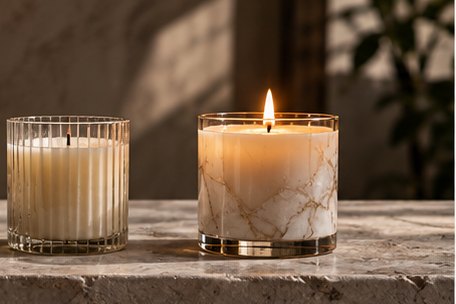
Désir · Candles for a more beautiful you · India · Australia
Guide · 5 min
How to choose a luxury candle in India
Price is the least useful signal. Here is what to look for instead: wax, throw, wick and whether the vessel has a second life.
India's candle market has grown up fast, and the shelf now runs from ₹400 tealights to imported vessels north of ₹15,000. The gap between them is not always quality. A luxury candle is defined by four things you can check before you buy, and none of them is the box.
The wax
Paraffin is cheap, throws well and burns dirty. Soy is clean but weak. The blends serious houses use now, coconut with rapeseed or soy, hold a higher fragrance load (ten percent is the mark of a real one) and burn cool, so the scent is released rather than cooked. Ask what the wax is; a brand that cannot answer is not a luxury brand.
The throw
Cold throw is what you smell from the shelf; hot throw is what fills the room. Sandalwood- and oud-based candles have quieter cold throw and a much larger hot throw, which is why the best ones seem underwhelming in the shop and overwhelming at home. Judge a candle after twenty minutes lit, never from the lid.
The wick
A cotton wick sized to the vessel makes a full melt pool by the third hour. If the first burn leaves a ring of hard wax, the candle will tunnel forever; that is a manufacturing fault, not user error.
The second life
A vessel that can be refilled turns a ₹2,400 purchase into a ₹1,400 habit, and it is the single clearest sign a house intends to be around. Désir's marble-lidded glass was designed for the refill first and the candle second.